

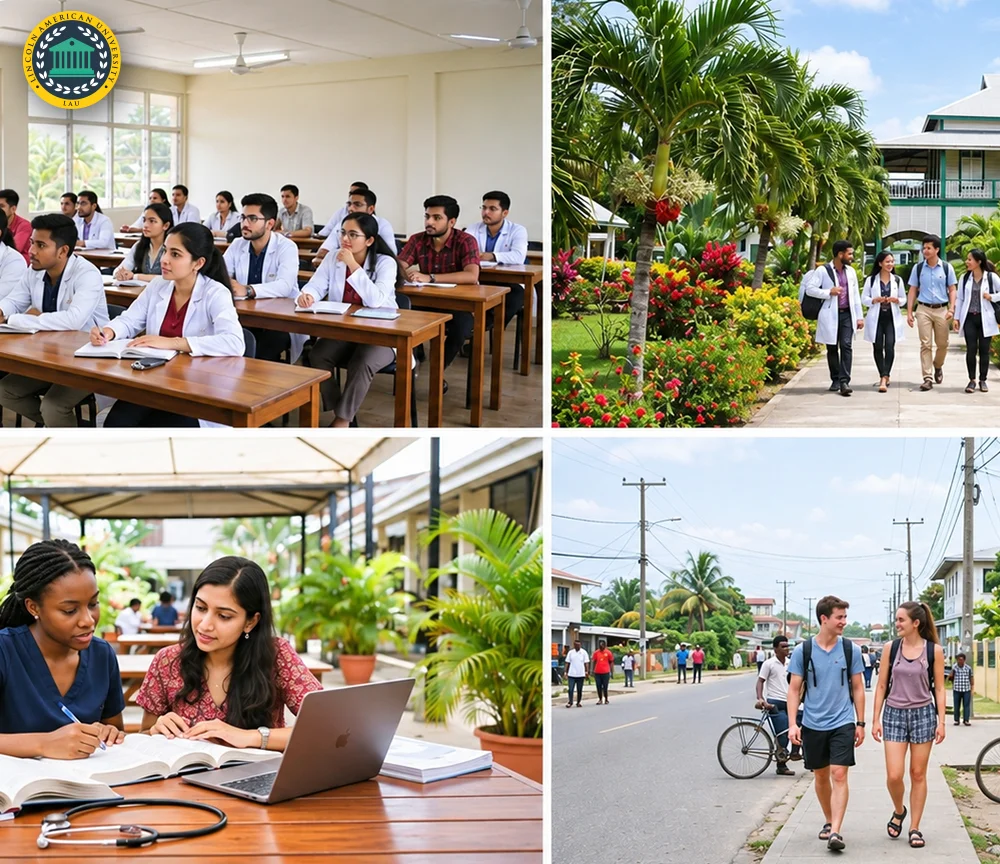
Joining medical schools in other countries involves more than choosing a university. Students must know how they will live, both academically and personally, once they join the school. Medical student life in Guyana includes classroom education, practice classes, campus life, self-study, and the chance to immerse themselves in a new culture.
If you wish to study medicine in Guyana, you must get acquainted with its academic life and environment. The MD program at Lincoln American University (LAU) is conducted in English medium according to the American educational system.
What Is MD in Guyana Like?
Consistency is required in the field of medical education. For instance, a typical day in class involves attending lectures, taking notes, studying subjects, and engaging in academic or practical work.
At Lincoln American University, the programme is divided into preclinical, paraclinical, and clinical phases. The MD programme takes five years, with one year of preclinical sciences, two years of paraclinical sciences, and two years of clinical sciences.
This implies that student life becomes different depending on how far learners are in the programme. Initially, learners study mostly the medical sciences before moving to the clinical phase.
Classes and Academic Learning
Classes form the core of medical student life in Guyana. Students study subjects that build their understanding of the human body, diseases, medicines, and clinical practice.
The paraclinical courses offered at Lincoln American University include subjects like anatomy, embryology, histology, physiology, pathology, pharmacology, and clinical medicine by system. Learning occurs through classroom lectures, laboratories, projects, and seminars.
It is advisable for students to revise each day after classes and not to wait until examinations come for revision to be done. Making notes, recalling information, and discussing issues with other students will make the process easier.
Campus Facilities and Student Environment
The campus forms an integral part of the life of a student. Some of the facilities available on the LAU campus include modern classrooms, laboratories, skill laboratories, accommodation, and a cafeteria. The laboratories are designed to facilitate practical training of medical skills.
With respect to international students, the availability of facilities for both academic and residential purposes in one place makes it easier for them to develop a routine. This will enable the students to attend classes, engage in practical sessions, study, and interact with their colleagues without limiting themselves to academic activities alone.
The university encourages participation in sports, other extracurricular activities, and cultural festivities.
A Typical Daily Routine for a Medical Student
The exact timetable can vary according to the semester, academic year, and scheduled activities. However, a student may organise the day around the following pattern:
Clinical Learning and Hospital Exposure
With advancement towards the clinical year, students' everyday activities become increasingly linked with healthcare environments. At Lincoln American University, the Clinical Science Program for years four and five consists of clinical rotations at affiliated hospitals in Guyana.
Learning through the clinical approach may involve observation and interaction with patients and healthcare professionals, taking patient histories, conducting physical exams under supervision, and comprehending diagnostic results. Students also keep logs for their clinical experiences.
This level differs from classroom-based education significantly since students apply theory in practice.
Life Outside Medical School
International students will also take some time to adjust to their surroundings. Guyana is characterized by a tropical climate, which is hot and humid. There is also plenty of rain; therefore, international students will have to prepare themselves for varying weather conditions in their daily plans.
Students can play sports, participate in cultural events, and explore their surroundings in their free time.
The students, especially those coming from India or another country, will be able to gain independence, communication skills, and cultural understanding through those activities.
Tips for International Students in Guyana
Students preparing to study medicine in Guyana can make their transition smoother by:
- Building a consistent study timetable from the beginning.
- Reviewing lectures regularly instead of relying only on examination preparation.
- Participating actively in practical and laboratory sessions.
- Asking faculty members for clarification when concepts are difficult.
- Maintaining a healthy balance between study, sleep, and recreation.
- Staying connected with family while building friendships on campus.
- Learning about local customs, weather, and everyday life before arrival.
Conclusion
Student life in Guyana can be a mixture of rigorous medical studies, learning through practice, campus life, and cultural adaptation. Medical students who want to get their MD in Guyana should be disciplined, revise regularly, learn actively, but also find time for socializing and living their life outside studies.
Medical education in another country - what you should know? Checking out academic programs and LAU’s compliance with NMC, WDOMS, and other facilities at the university under consideration can help future medical students in making their choice. Remember to check with the relevant authorities for all admission and compliance requirements.
FAQs
Is English used for medical education in Guyana?
At LAU, the MD programme is conducted in English, which can support international students during classroom and academic activities.
What does a medical student's daily routine include?
It may include lectures, practical sessions, laboratory work, revision, assignments, clinical activities, and personal time. The exact schedule varies by academic stage.
Does medical student life in Guyana include clinical training?
Yes. At LAU, clinical training is included in the fourth and fifth years through rotations at affiliated hospitals in Guyana.
Can international students participate in extracurricular activities?
Yes. LAU highlights sports, cultural celebrations, community activities, and other opportunities beyond classroom learning.