
Studying medicine in the Caribbean and training in the United States is connected, but they are not the same stage. Students first complete their medical education, and then they work through examinations, certification & clinical requirements before applying for US residency.
In this piece, we will dive deeper into how an MBBS student can pursue their clinical rotations in the United States of America. We will shed light on the steps involved and key takeaways for you to start your medical journey as a doctor in the US.
Requirements to Pursue a Medical Career in the USA
- Medical School: Complete your medical degree at an eligible medical school.
- USMLE: Pass USMLE Step 1 and Step 2 CK to meet the medical science examination requirements.
- Clinical Training: Gain clinical experience through medical school rotations and other relevant clinical opportunities.
- ECFMG Certification: Meet the applicable examination, clinical skills, communication skills, and credential requirements for certification.
- Residency Application: Apply to suitable U.S. residency programmes through the relevant application process and meet their eligibility requirements.
What Is the Caribbean Medical School-to-USA Pathway?
The Caribbean medical school pathway can help students pursue medical training and residency opportunities in the United States, subject to eligibility and licensing requirements. Lincoln American University (LAU), School of Medicine provides an MD program where students study according to the US curriculum and gain clinical experience as well as prepare for the USMLEs. Students seeking to do residency in the US must also satisfy examination and ECFMG requirements.
Step 1: Starting Medical Education in the Caribbean
The early years focus on foundational sciences such as anatomy, physiology, biochemistry, pathology, pharmacology & microbiology.
Building a foundation for USMLE
Students who intend to pursue US graduate medical education should plan for the USMLE early. Current ECFMG requirements include passing Step 1 and Step 2 CK to meet the medical science examination requirement.
Step 2: Moving From Basic Sciences to Clinical Education
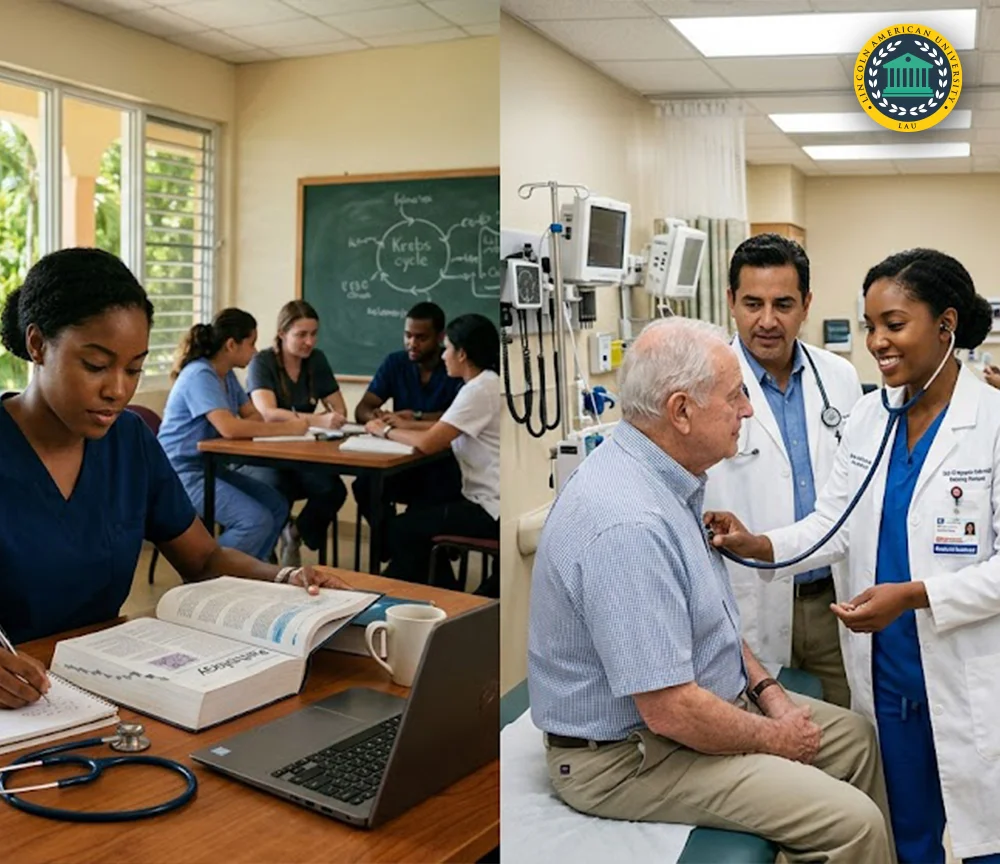
Learning shifts from the classroom to patient interaction and the hospital environment.
What happens during clinical education?
Students typically practise:
- Taking patient histories and performing physical examinations
- Joining case discussions and clinical decision-making
- Writing clear documentation
- Communicating within a care team
- Rotating through different specialties
These experiences are called clinical clerkships or clinical rotations.
Step 3: What Are US Clinical Rotations?
US clinical rotations are supervised clinical experiences in healthcare settings. They give medical students exposure to the US healthcare environment.
How Do Caribbean Students Reach US Clinical Training?
A general framework looks like this:
- Pre-clinical Education: Students build a foundation in subjects such as anatomy, physiology, pathology, and pharmacology.
- School’s Clinical Curriculum: Students develop clinical knowledge and practical skills through structured medical coursework and supervised training.
- Affiliated or Approved Clinical Sites: Medical schools arrange clinical training through hospitals and healthcare facilities that meet their programme requirements.
- US Clinical Rotations: Students gain supervised, hands-on clinical experience in US hospitals, subject to their school’s arrangements and eligibility requirements.
- Completion of Medical Education: Students complete the required academic and clinical components to graduate with their medical degree.
The exact structure differs by school. Some have established clinical-site networks, while others use different arrangements. The availability, location & structure of US clinical rotations depend on each school's curriculum and clinical-site arrangements. Anyone considering the Caribbean medical school-to-USA route should ask these questions directly.
Step 4: Where Does USMLE Fit Into the Journey?
Timing varies, so treat this as a general pathway, not a fixed schedule:
- Basic Sciences: Build a strong foundation in medical subjects during the initial years of medical school.
- USMLE Step 1: Take the exam after completing the required basic medical science coursework and meeting eligibility criteria.
- Clinical Education: Develop clinical knowledge and patient-care skills through supervised clinical training.
- US Clinical Rotations: Gain clinical experience in the United States where available and permitted by your medical school.
- USMLE Step 2 CK: Demonstrate clinical knowledge and meet the applicable exam eligibility requirements.
- ECFMG Certification: Fulfil the required examination, medical education credential, and clinical and communication skills requirements before applying for certification.
ECFMG states that students at eligible international medical schools can be eligible for Step 1 and Step 2 CK while enrolled, subject to its requirements.
Step 5: Meet ECFMG Certification Requirements
To pursue residency training in the United States, international medical graduates must meet the applicable ECFMG Certification requirements.
- Medical School Eligibility: Your medical school must have an ECFMG Sponsor Note in the World Directory of Medical Schools, covering your graduation year.
- Medical Degree: You must meet the required medical education credits and provide your final medical diploma.
- USMLE Exams: Pass USMLE Step 1 and Step 2 CK.
- Clinical and Communication Skills: Meet the applicable ECFMG Pathway requirements, including a satisfactory OET Medicine score, or qualify through a valid former Step 2.
Always check the official ECFMG website for current requirements.
Step 6: Apply for US Residency
After completing medical school and meeting the requirements, eligible graduates can apply for residency programmes in the United States.
- Prepare Your Application: Gather your academic records, examination results, and other required documents.
- Apply Through ERAS: Submit applications to suitable residency programmes using the Electronic Residency Application Service (ERAS).
- Attend Interviews: Participate in interviews with programmes that shortlist your application.
- Participate in the NRMP Match: Follow the National Resident Matching Program (NRMP) process to seek a residency position.
- Begin Residency: If matched and all programme requirements are met, start supervised postgraduate medical training.
Caribbean Medical School to US Clinical Training: The Journey at a Glance
Conclusion
The Caribbean medical school to US clinical training journey has several distinct stages: education, examinations, clinical experience, certification & residency application. Each depends on the school and on current ECFMG rules, so verify details early. To compare options, review the LAU admissions information and speak with the admissions team.
FAQs
Do all Caribbean students get US clinical rotations?
No, availability depends on each school's curriculum and clinical-site arrangements.
Is ECFMG certification the same as a residency placement?
No, certification does not guarantee acceptance into a US residency program.
Which USMLE exams does ECFMG currently require?
USMLE Step 1 and Step 2 CK.
Are Caribbean medical schools recognized in the US?
Yes, Caribbean medical schools are recognized in the U.S., provided they are accredited by bodies recognized through the World Federation for Medical Education (WFME) or the U.S. Department of Education (such as CAAM-HP or ACCME).
Is a Caribbean medical degree valid in India?
Yes, a Caribbean medical degree is valid in India, provided the university and program meet the National Medical Commission (NMC) 's strict guidelines.